Objecting to the Great Wolf Lodge application
- nowolfhere
- Jul 30
- 4 min read
Planning application 26/00020/FUL - land south of Springfield Farm, at the corner of Gapsick Lane and Worksop Road, Whitwell Common
A guide to the issues , for people writing their own objections - July 2026
About this guide
This guide sets out the main planning issues raised by the application, and what the Council’s own consultees have said about them. It is intended to help you write your own objection. Everything in it is drawn from documents on the Council’s public planning register, which anyone can read. Please do not copy this document, or anyone else’s objection, word for word. Where a planning authority receives a large number of identical or near-identical letters, they are commonly treated as a single representation and carry very little weight. A short letter in your own words, about the points that matter to you, counts for considerably more than a long one that has been copied. Use this guide to find the issues that concern you, then write about those in your own way.
How to make your objection count
• Quote the application reference 26/00020/FUL and give your name and full postal address. Objections cannot be anonymous.
• Write in your own words, and say how the proposal affects you or the area you know. • Stick to planning matters. The list on the last page shows what does and does not count.
• You do not have to cover everything. Two or three points made well are better than a list of everything in this guide.
• Say clearly at the start that you object, and why. If you want the Council to require further information before deciding, say so.
• Send it as soon as you can. The Council has not yet published its officer’s report, and representations can be made up to the point of decision, but earlier ones are more likely to shape that report.
What has changed recently — in brief
The position has moved significantly during June and July 2026. Several of the Council’s own statutory consultees have now either objected, or have said they cannot yet advise, or have said the application should not be supported. These are not objections from residents. They are the formal responses of the bodies the Council is required to consult.
• Derbyshire County Council, as the Lead Local Flood Authority, first objected on 25 March 2026 and confirmed on 16 July 2026 that its objection stands. It says it cannot give an informed view until the applicant shows that the proposed outfall ditch connects to a wider network of watercourses.
• Derbyshire County Council, as the highway authority, wrote on 20 July 2026 formally recommending that the application be deferred pending additional information. It has not said the scheme is acceptable.
• Derbyshire County Council’s planning policy team concludes that, in its current form, the proposal should not be supported, and that substantial revisions and stronger evidence would be required before any support could be considered.
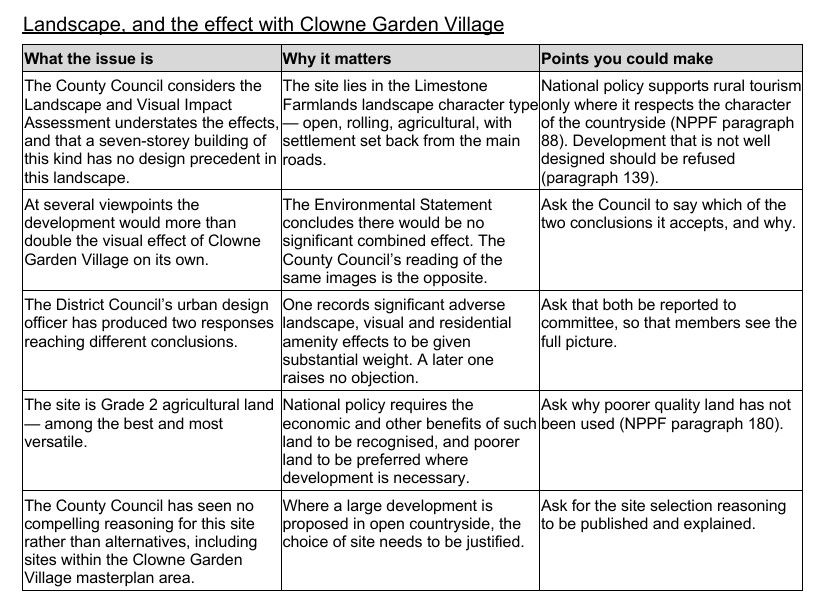
• The County Council also finds that the applicant’s own Verified Views provide strong evidence of combined effects with Clowne Garden Village, and that at several viewpoints this development would more than double the visual effect of Clowne Garden Village on its own. The applicant’s Environmental Statement concludes there would be no significant combined effect.
• Historic England has not withdrawn its position that, while there would be harm to heritage assets, it cannot assess how much harm without further information. Planning application 26/00020/FUL — page 1 of 5 Planning application 26/00020/FUL — page 2 of 5
• Nottinghamshire Wildlife Trust has objected. Derbyshire Wildlife Trust considers breeding bird surveys essential; they have not been carried out.
• Active Travel England has issued only generic standing advice, most recently on 16 July 2026. That is not approval of the scheme.
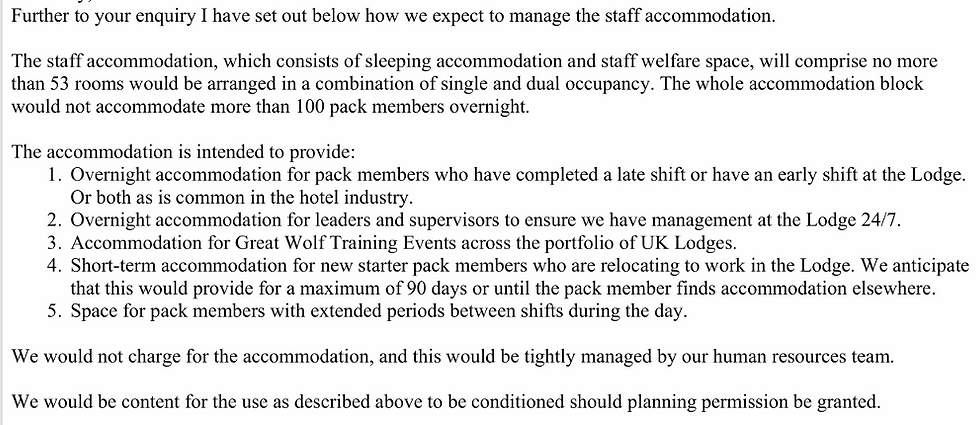
• On 9 June 2026 the applicant told the Council that the staff accommodation block would have no more than 53 rooms and would house no more than 100 people overnight. The Environmental Statement says it accommodates approximately 200 staff. Those two statements cannot both be right.




What counts, and what does not
Planning objections must be based on what are called material planning considerations. Points outside that list are usually disregarded, however strongly felt, so it is worth avoiding them.
These do count
Traffic generation, highway safety and access; noise, light and disturbance; loss of privacy or overshadowing; landscape and visual impact; effect on heritage assets and their settings; drainage and flood risk; effect on wildlife and protected species; loss of agricultural land; design, scale and appearance; conflict with the Local Plan or national planning policy; adequacy of the information supplied by the applicant.
These do not count
Loss of a private view; effect on property values; competition with an existing business; the identity of the applicant; boundary or ownership disputes; matters controlled by other legislation, such as licensing or building regulations; the personal circumstances or conduct of the applicant, unless they bear on a planning matter; and moral objections to the type of development.
Where to send your objection
Objections should be sent to:
Bolsover District Council, Development Control,
The Arc,
High Street,
Clowne,
Derbyshire
S43 4JY,
or by email to
Quote the reference 26/00020/FUL.
You can also comment through the planning pages of the Council’s website, where all the application documents referred to in this guide can be read in full.
If you would like to check anything in this guide, every document mentioned is on the public planning register under that reference.
This guide has been prepared by a local resident who has objected to the application.
It is a summary of publicly available documents, not legal advice, and it does not set out every issue. Please read the documents and form your own view.
Planning application 26/00020/FUL


Comments